Wednesday, September 23, 2015

Therapy and Your Purse


A purse is more than just a fashion accessory when you are a speech pathologist... it's a chew toy, a hiding spot and even a germ magnet.  

Let me tell you about the adventures I have had with my purse. In doing so, I want to share 3 important lessons I've learned about therapy and purses. I'll start at the top...

#1:  Don't take your eyes off your purse

One afternoon, I was working with a preschooler at a nearby daycare. As we were playing, I  glanced up to see that she was wearing my sunglasses. She saw them in my purse and helped herself. "Awww, how cute!" 

She laughed and smiled, and so did I, until...snap! She broke the left arm off my sunglasses when she tried to put them on top of her enormous head. Oh, brother!

On another visit with the very same little girl, she spotted my car keys. They hang on the outside of the purse so they're easy for me to find. She took them off then latched them back, took them off and latched them back. 

"What a fun game! You're very good at that! Now, let's get back to work."

When our time was up, I gathered my things, dropped her off at her classroom and made my way to the parking lot. I quickly realized...I've lost my keys.  It took nearly 20 minutes to find those darn car keys...the little girl had put them in her pocket. Ugh!  

A few months later, I was doing a home health visit with an adult patient. She had a  cute, fluffy little dog that was prancing around, in and out of the room, carrying along a variety of dog toys. "What an adorable dog. She really loves to play!"

Well, this precious little fluff ball turned vicious when it came time for me to leave. She was jumping on me and barking like crazy. Come to find out, she dropped her tennis ball in my purse when no one was looking, and she was in attack mode because I was about to leave with it.

Lesson finally learned: don't take your eyes off your purse. 


#2:  Don't put your purse on the floor

Nothing good happens when you put your purse on the floor... believe me, I know!

Once, an eager little puppy chewed the strap off my leather purse while it was sitting on the floor. That's right, as I was busy guiding practice through oral motor exercises, that puppy was chomping on my purse. 

The purse sat in my closet, out of order, for nearly three years before I decided to have it repaired. 

On another occasion,  I went to see a patient for a dysphagia therapy session. His hospital bed was in the living room of the tiny home and two big dogs sat alongside. With very little space, I put my purse on the floor where I stood and got busy. The wife commented, "The dogs are very protective of my husband. They never leave his side."

When it was time to go, I reached down to gather my things.  My purse was sitting right in the middle of a yellow puddle. Yup, that's right, the dog had peed all over my new purse. That was so disgusting, the purse has never been used again.

My occupational therapy friend, Teri, once told me a story about putting her purse on the floor. While she was working, roaches crawled into her purse. Gross! But that wasn't the biggest problem. The real fiasco began when the roaches crawled out of her purse into the front seat of her car as she was driving. Wow! 

I was glad to know that I am not the only one with a purse story, and again, I finally learned:  don't put your purse on the floor.

#3:  Purses are dirty

A recent study by Initial Hygiene has revealed that women's handbags are contaminated with more bacteria than the average toilet. Yuck!  

In fact, tests showed that one in five handbag handles contains enough bacteria to actually make you sick. 

Because purses come into regular contact with our hands and a variety of surfaces, the risk of transferring different germs onto them is very high, especially since bags are rarely cleaned. 

Tests conducted by the research group revealed that leather handbags are the most bacteria-riddled of all purses as the spongy texture provides the perfect surface for bacteria to grow and spread. The research also revealed that the dirtiest items in the average purse are bottles of hand cream,  tubes of lipstick and mascara. 

Experts suggest that women regularly clean their hands and their handbags with antibacterial wipes or gel to prevent cross-contamination. I suggest you never again use a purse that a dog has peed on.

Do you have a funny purse story? I would love to hear it. In the meantime, keep your eyes on that dirty purse of yours and, by all means, keep it off the floor.

Monday, September 14, 2015

Combat stress with this quick fix


The de-frazzler you have in your purse:  gum!

That pack of gum you carry around in a case of a garlic emergency can freshen your mood as well as your breath.  According to Huffpost Healthy Living, researchers from Australia and England found that when agitated people chewed gum, they felt less anxious, more alert and had 18% less cortisol (the stress hormone) in their saliva. The study authors hypothesize that chewing increases blood flow to the brain, which helps with alertness and may also distract us from stressors.

So, before you have a  Monday afternoon melt down, find some gum and get smacking!


Wednesday, September 9, 2015

How Do You Measure Up?

As I was moving about my work day today, I realized I was using the same app over and over again. North side, south side, young and old, if you were getting therapy from me today, you were looking at my sound level meter.

Have you heard about this wonderful thing, the sound level meter? Well, let me tell you all about it!


A scientist would tell you that a sound level meter is an instrument that measures sound pressure levels, but that sounds kind of spooky to most people.  So, the way I explain it, "It's what  I use to measure the loudness of something."

It's an app I downloaded from the App Store a few years ago. It's made by Sky Paw Co. Ltd. and is currently in it's 10th edition. Did I mention... it's free? You can get rid of pesky pop ups and banner ads for a mere 99 cents, but I never did that. And good news for you guys with Android devices, the free app is also available from Google Play.

The app developer says that it "precisely measures the sound pressure levels all around you" but  goes on to say, "We've tried our best to make the app as accurate as possible, but this app is intended for entertainment purposes only." Since I'm not conducting scientific research,  "as accurate as possible" sounds great to me!

The Sound Level Meter:
A Handy, Dandy Tool for SLPs


Provide education:  

Using the sound level meter as a visual reference, it is a snap to provide education to patients and family members regarding volume.


  • Teach the basics about environmental noise 
  • Explain normal parameters for conversational loudness
  • Make recommendations on how to decrease environmental noise
  • Give information about compensatory voicing techniques
  • Use as a reference when teaching about good vocal hygiene
  • Explain vocal misuse and/or hyperfunction
  • Teach the correlation between breathing and voicing as it relates to intensity and duration
  • Discuss the consequences of inadequate intensity 
  • Explain auditory comprehension compensatory strategies


Provide feedback:

Prompts and cues are great, but visual feedback is a highly effective way for your patients and family members to understand their performance levels.

  • Help your patient see how they measure up
  • Show your patient what is normal, too soft or too loud
  • Demonstrate appropriate and effective performance levels
  • Show your patient target volume levels
  • Provide measurable data to show changes over time
  • Use the plotted history to quickly see the effect of adjustments being made

Daily use in therapy:

As I mentioned earlier, I have found numerous ways to incorproate a sound level meter into my daily treatment sessions. Besides voice therapy, I have also used this device when working with persons with Parkinson's Disease, Dysarthria and Dysphagia. Here are just a few examples:

  • Practice using increased volume to enhance intelligibility
  • Practice using decreased volume to diminish vocal misuse
  • Enable patients to see pauses between words when practicing slow rate
  • Practice producing a strong, effective cough
  • Practice producing a strong, effective throat clear
  • Teach the patient to monitor and/or assess their own performance


Other neat benefits:

There are a variety of sound level meters out there, this one just happens to be my favorite because of some of the cool features.

  • shows average, peak and max values
  • gives real life examples of loudness equivalencies
  • creates a plotted history of average values
  • easy to use
  • quick on and off using play and pause
  • record and export data for future analysis
  • large digital numbers are easy to see
  • allows for calibration 
  • sensitive up to 110 decibels 
  • able to be used on iPads and iPhones
  • compatable with Android devices 
  • cool new overlay feature

   Decibel 10th: Pro Sound Meter- screenshot


While it may be true that quiet people have the loudest minds,  a quiet voice is generally ineffective. So, as you go about your work this week, consider who you know that may benefit from the feedback a sound level meter provides. Download the app and give it a try...what have you got to lose?


The volume of your voice does not increase the validity of your argument.
Steve Maraboli

Thursday, September 3, 2015

Look Left: Compensating for Hemispatial Neglect (Part 2 of 2)


Hemispatial neglect, also known as left neglect, results most commonly from brain injury to the right cerebral hemisphere and causes visual neglect of the left hand side of space. When half of your visual field is lost, half of the world is gone.  The consequences of neglect can range from humorous to devastating, but one thing is certain, compensation will be necessary during the recovery process. Here are a few tips from the pros.


Compensating for Neglect

Left Sided Neglect and Mobility

Persons with neglect are at a higher risk for accident, injury and fall. Take precautions to increase safety and awareness.

Image result for wheelchair tray

Use a wheelchair tray or trough when seated;  use a sling or other positioning device when walking

  • prevents subluxation of the shoulder
  • prevents injury to the arm, hand, elbow
  • keeps the limb visible 
  • increases body awareness


Outline doorways with bright tape 

  • increases environmental awareness
  • provides a point of reference when seeking the left visual field
  • prevents collision and injury with door frames
  • increases safety
  • reduces risk for fall

Clear the way

  • eliminate necessary obstacles on the left side
  • provide clear, clutter free paths
  • offer verbal and visual cues as needed

Stand or walk next to the person on their affected side
  • encourages them to look and scan to the left
  •  enables you to steer them away from obstacles
  • increases safety- reduces risk of colliding, tripping or falling


Left Sided Neglect and Meal Time


Not only will persons with visual neglect eat only half of the food on their plate, they will not be aware of things on the left side of the table. It is important to consider the entire dining environment.  Small changes can make a big difference.


  • Place napkin, utensils, beverages and yummy deserts on the left side of the table
  • Rotate the plate during the meal to ensure all food is consumed
  • Sit on the person's left side to draw their attention that way
  • Use hand over hand techniques to facilitate use of left hand, when appropriate
  • Give verbal and tactile cues as needed
  • Tape a line down the center of the table or tray where the meal is being served
  • Avoid distractions and eliminate clutter


Left Sided Neglect and Activities of Daily Living


Neglecting half of the body can be problematic when considering hygiene and dressing. Compensatory strategies to the rescue!


  • Dress, shave or wash the left side of the body first and then the right
  • Encourage the use of the left hand as much as possible
  • Label drawers to indicate contents within
  • Place all necessary items to complete the task to the left
  • Use a mirror to provide feedback
  • Provide verbal and tactile cues as needed
  • Eliminate distractions
  • Reduce clutter
  • Limit choices


Additionally, there is a tremendous variety of adaptive equipment to make life easier for the person with hemiplegia and associated visual neglect. Occupational therapists are the experts here and can assist with selecting appropriate devices or pieces of equipment

Try to let the person do as much as they can for themselves. It may be easier and save time for you to do the task, but the person will become less independent unless they try to do tasks on their own. 


Left Sided Neglect and the Environment

Retraining an individual to attend to the left side of their world takes time and persistence. Consistent attention to the left, even during leisure activities or when visiting with a friend, can speed the recovery process.

Place frequently used items or objects on the left
  • remote control
  • glasses
  • water
  • phone
Position bed to encourage looking toward  windows and doorways

Position TV or radio on the left 

Sit on the left side of the person

To avoid startle, approach from the right


Left Sided Neglect and Reading or Writing

Reading and writing abilities can be significantly limited by changes in the visual field. External cues and simple modifications are helpful.


  • Draw a brightly colored line down the left side of the page- cue to use as a reference point for finding the left margin
  • Use a ruler, index card or blank piece of paper to follow the lines of text
  • Number the lines in order to follow proper sequence and avoid skipping
  • Follow along using a finger
  • Use enlarged print or double spacing 
  • Cue and prompt as needed


Neglect affects all aspects of a person's life. Encourage families and caregivers to learn more about ways they can assist in recovery. Incorporating compensatory strategies during the rehabilitation process can increase awareness, safety and ultimately, independence. 


Helping a person will not necessarily change the world, but it will change the world for that person. 
Unknown


Monday, August 31, 2015

Look Left: The Basics of Hemispatial Neglect (Part 1 of 2)


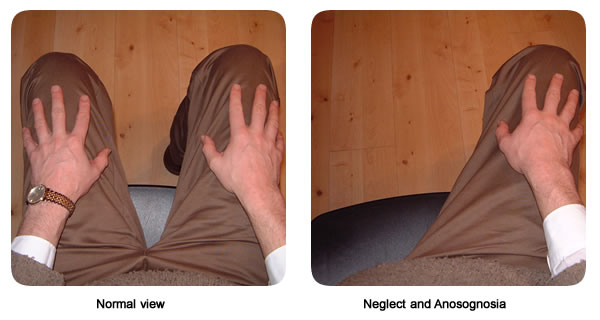
Hemispatial neglect, also known as left neglect, results most commonly from brain injury to the right cerebral hemisphere and causes visual neglect of the left hand side of space. Although it most often affects visual perception, neglect in other forms of perception can can also be found, either alone or in combination, with visual neglect. 


No matter the reason or the result, witnessing neglect in a stroke survivor is a mind blowing experience. They teach us about it in school, but when you experience it first hand, you're almost guaranteed to be amazed.


I clearly remember a woman I was working with at a rehab hospital in Houston. She had visual and perceptual neglect of the left side of her body.  Not only did we have trouble getting her to see the things on the left of midline, she literally did not recognize the left side of her body. 


I was working with her during a therapeutic lunch meal, trying to get her to eat the food on both sides of her plate, when the neglect became apparent.


Ms. P: What is that?
Me:  That's your arm. 
Ms. P:  No it's not.
Me:  Yes, ma'am, it is. It is your left arm.
Ms. P:  That's not my arm. That arm is fat and ugly.
Me:  It's a little puffy, but it is your arm.
Ms. P: Get that thing out of here. It's disgusting. 
Me:  But it's your arm, we can't get rid of it.
Ms. P:  Well, you're a smart girl, I'm sure you can think of something. 


I thought she was joking, but it was no laughing matter for her...she wanted that arm gone or she was not going to eat.


Just this week, I had another run in with left neglect. I was so busy coaching the patient through his safe swallow strategies, I didn't notice, until the end of the meal, he had only eaten half of the food on his plate. It's almost a perfectly straight line down the middle of the plate...unbelievable


Quick, snap a picture!  This is good material for a blog!


So, if you've read this far, you've learned two of the signs of left neglect, but there are more...


Signs and Symptoms of Left Neglect

  • Frequently bumps into objects, furniture, door frames or people on the left
  • Unsure of footing while walking, with stumbling or tripping
  • Often startled by moving objects or people appearing suddenly on the left
  • May have bruises on left arm, shoulder, elbow or hand
  • Frequently loses place when reading and becomes frustrated when reading
  • Struggles to find or misjudges the start or end of a line of print in reading
  • Only writes or draws on the right half of the page
  • Problems in finding things on desks, counter tops, cabinets or closets
  • Fear or anxiety in walking through unfamiliar areas
  • Eats the food only on the right side of the plate
  • Little or no awareness a hemisphere deficit exists
  • Difficulty acknowledging the left side of the body
    • Comb only half of their hair
    • Put on only one sleeve of their shirt, or one leg of their pants
    • Wash only the right half of the body
    • A woman may apply makeup to only the right half of the face
    • A man may only shave the right half of his face


Model on the left. Patient's drawing on the right.

Left sided neglect


The stylish half beard


Okay, so now that we can identify hemispatial neglect, what are we going to do about it? Please check back for part 2 of this blog. I'll give you tips and tricks you can use to compensate for neglect or increase safety with mobility, during ADLs, at mealtime, when reading and writing.

Thanks for reading...hope it's a great week!


What we see depends mainly on what we look for.
Unknown

Images courtesy of cognitiveneuro.wordpress.com, Stroke4Carers.org and gainesonbrains.com


Wednesday, August 19, 2015

Back to School: The Importance of Schedules and Routines


For many, back to school means back to old, familiar routines. You know, the ones parents love and the ones  children dread:  wake up time, homework time, limited TV time and bed time. 

In attempt to get back to the grind, some of my friends have pulled the plug on summer fun two weeks before the first day of school, insisting that their kids go to bed at 8:30 every night and wake up at 7:00 every morning. Another mom I know has turned off the TV and is requiring her kids to read and do practice math problems all the live long day. Those poor kids.

At our house, we take the easy breezy approach. In fact, just this morning as I was fretting about our back to school strategy, my husband said, "We've been here before. We know exactly what to do. I don't understand why you are so worried."

I hate it when he is right.

The obsessive compulsive part of me loves schedules, routines and an overall sense of order. I suppose that's why back to school isn't such a big deal, because each member of my family knows what to expect when the time comes.


But what about those people that don't understand the importance of routines? What about the mom I met this week that was too busy texting to notice that her newborn has missed a feeding?  Well, this post is just for you! 


No matter what your circumstances, I hope to convince you that schedules and routines are both helpful and necessary for people of all ages. 


Schedules, routines and babies


A baby has two important jobs:  to sleep and to eat. Establishing predictable routines takes work, and babies needs help developing consistency from the very beginning.  

A sleeping schedule helps babies establish healthy sleep cycles and prevents them from being overtired. Schedules  can eliminate  confusion and solidify a sleep-wake cycle so that days and nights are not confused.

Schedules provide time frames for feedings so that they are not missed or provided unnecessarily. Predictable schedules for eating also allow parents to eliminate some of the guess work when asking, "Why is my baby crying?" If it's been 3 hours since the last feeding, then a baby is likely to be hungry. If the baby took a bottle just 30 minutes ago, better check the diaper.

Routines prevent melt down, help baby to cope during difficult times and promote the development of strong bonds with parents and caregivers. Schedules promote good habits that can last a life time.

I started my son Jay on a three hour schedule before we even left the hospital. Using the book On Becoming Baby Wise by Gary Ezzo, I helped him establish a routine cycle of sleep, eat, and play. The schedule I set for my baby not only made our first year together easy and predictable, it made me feel like the smartest mom in all of the land.

Schedules, routines and children


Regular schedules provide the day with a framework that orders a young child's world. Although predictability can be tedious for adults, children thrive on sameness and repetition. Routines help kids understand the importance of following  rules. Schedules provide security by reducing the fear of the unknown. 

Children learn cooperation and independence by following established routines. Parents  enable their kids to learn self control and self discipline when there is a predictable schedule to follow. Routines built around fun or spending time together strengthen relationships between parent and children. What's more, researchers have shown children following routines are happier and more confident than those that don't. 

The schedule I set for Jay continued into his second year. It was good for him but it was really great for me. The routines of the day were so well ingrained, by the time he was a toddler, things were set in stone and that little guy was on automatic pilot. When other parents were running around, chasing kids or working frantically to make a case for bedtime, Jay would come to me and ask, "Can I go to bed now?" 

Our routine made me feel like a parenting super star!

Schedules at home


One of a family's greatest challenges is to establish comfortable, effective schedules and routines that result in a happy compromise between disorder and rigidity, confusion and boredom.

While the goal is not regimentation, experts agree that some routine at home is helpful. Families can use schedules to organize and get through the things that need to be done each day, including breakfast, homework, dinner and bed time.  While every family has its own daily habits, schedules and routines help family members know who should do what, when, in what order and how often.

At our house, even our dog Ozzy follows a schedule.  He knows when it's time for breakfast because the boys have been feeding him routinely since he was a puppy. They wake up at 7:00 am, get dressed, make their beds, comb their hair and come downstairs for breakfast. If Ozzy's "corn flakes" and fresh water are not out for him by 7:30 am, he's barking like crazy. (Unfortunately, that includes Saturdays and Sundays too...so much for sleeping late.) Because of our daily routines, that dog never has and never will miss a meal.

Ultimately, a good routine caters to the needs of all family members (even the pets), teaches responsibility and builds strong family bonds. 


Routines at work


Routines at work provide a sense of structure that enable you to focus your time and energy during the work day. When you are focused, you are more thorough and more productive which saves you time and enables  you to accomplish more. Schedules can also greatly simplify your work day so it doesn't become overly chaotic or complicated. 

One of the most convenient reasons why structure at work is important is because it negates the need to regularly schedule your days ahead of time. You already know what you are doing each and every day. How convenient!
Most importantly, routines at work put you in control of your day, instead of putting you at the mercy of incoming requests. When you have a working routine, you have a great way for saying "no" to  tasks, to websites or to the people that want your time.


Routines and you


Personal routines allow you to organize your life so that it makes sense to you. You can actually wake up with a sense of ownership, order and organization. The predictability of a routine can help you feel much calmer and in control of your life. In fact, it's been proven that routines help you  manage your time, decrease interruptions, improve your health, increase your willpower and even reduce stress. 

Because a routine is something you do over and over again, it eventually becomes a habit. At that point, you don't need to think to act. The automation  increases your efficiency and enables you to do things without consciously thinking about it. You can automatically get things down without having to remind yourself to get things done. How cool is that?

Understanding that the first 60 minutes of the day can set the course for your mood, your energy, your focus and your entire day, I decided to begin a new morning routine this year. After all, if you want the day to be amazing and extraordinary, you have to focus on how the day begins. 

I heard about Hal Elrod's book The Miracle Morning and immediately started implementing his routine. Of course, you will want to read the entire book, but his basic six minute morning routine (silence, affirmation, visualization, exercise, read, scribe) has been an excellent way for me to start my days.  Check it out and see for yourself...it may be just what you need.


This week, as you go about your work, think about how schedules and routines impact your daily life. Do you need to make any adjustments? Do you know someone who does? Be sure to share this information with family members and caregivers that can benefit... there may be a hungry baby out there who will be glad you did. Good luck!

Thanks for reading...have a great week!  


You will never change your life until you change something you do daily. The secret of your success is found in your daily routine.
John C. Maxwell


Wednesday, August 12, 2015

Mobility in America: 10 Very Simple Ways Older Adults Can Be More Active


In a study recently published by the Centers for Disease Control and Prevention, one out of every five adults in the United States has a disability. That's a staggering statistic if you ask me.

The researchers also found that the highest percentages of people with disabilities are generally in the Southern states. 

The report did not determine why differences occur by state. However, states in the South tend to have the highest rates of chronic diseases, such as heart disease, obesity and diabetes, which are typically associated with disability. 

I wasn't too surprised by that news, because, for two years in a row (2010 and 2011),  Corpus Christi was the Fattest City in America. What was alarming were the actual percentages:  31.5% of adults in Alabama and 31.4% of adults in Mississippi and Tennessee are disabled. What's going on y'all?

The report indicated  the most common functional disability, which was reported by one in eight American adults,  was "mobility limitation." 

Extreme heat and summer vacation laziness have combined to cause "mobility limitations" for my children this summer- I practically have to push those kids through the door to get them outside. But, that's not what the CDC is talking about. Rather, they define a mobility limitation as "serious difficulty walking or climbing stairs."

Like so many things, mobility is one of those things most of us take for granted until we begin to lose it. That's usually the point in time when we realize that even a simple, relatively uneventful day requires a great deal of strength, balance, coordination and stamina.

So, what are we to do?

Experts agree that the single most important thing you can do to remain mobile and independent is to engage in regular physical activity. We need to be active and to stay active. Aging Americans, including the patients on your caseload, need to be told: Never Stop Moving!

Some may say, "It's too late. I haven't been physically active in years. What good would it do if I started now?"

For the vast majority of people, it is never too late to start. Evidence shows that starting a regular exercise program even after decades of inactivity brings great health benefits.

Of course, people who are older and out of shape will need to start slowly and increase their exercise program incrementally, but come on everyone...let's get moving. 

We've all heard that it's smart to take the stairs instead of the elevator, or park  a little further and walk a little more. But, let's be honest, most of our patients can't handle such heart pumping activities.


Here's a short list of practical things anyone can do at home:
  • stand or pace while you talk on the phone- it puts you on your feet
  • play with your pet- it's good for both of you
  • do a little dance- find a partner and sway along with the music
  • dust, sweep, mop, or clean something- anything
  • wash dishes- bubbles can be so much fun
  • fold clothes- score bonus points with this one
  • exercise while you watch TV- pedal a bike, use bands or light weights
  • assist with or prepare a meal-  set the table while you're at it
  • stretch- you could even try yoga
  • wave your hands in the air like you just don't care- that's really fun

This week, as you go about your work, in addition to all of the other guidance and recommendations you provide, when appropriate, consider encouraging your patients, friends and family to get moving using some of these simple, functional activities. 

Share this post and spread the word...limited mobility leads to disability! 

If you have any other ideas for senior appropriate physical activities, please leave your comments below. I would love to hear from you.

As always, thanks for reading...have a great week. Now, get out there and go move that body of yours.


A body in motion will remain in motion. A body at rest will remain at rest.
Sir Isaac Newton